Foresight and Strategy in the Anthropocene

Stress-test your strategy before the future does.

1 to 3 daysFictional or tailored case5 futuresHorizon 2040 or your ownEspañol · English · Français
The problem

Forecasting a single future is no longer enough

Most organisations extend the trends they know and build their strategy on that future. In the Anthropocene, the future branches and sometimes breaks: thresholds, cascades, policies that change overnight.

Forecast

The future we expect: extrapolate, pick the most likely scenario and optimise for it.

Foresight

The futures we don’t expect: explore several worlds, their risks and thresholds, and look for what holds in all of them.

The programme

Three stages, from one future to many

A collaborative, collective-intelligence workshop in foresight and strategy, to stress-test your strategy across several futures and come away with robust decisions. It is built on the scientific state of the art and the reference literature in foresight.

Stage 1 · Forecast

The future we expect

What future do we expect?

  • 18 trends that will shape 2040
  • A futures wheel to trace their knock-on effects
  • The expected scenario and the strategy built for it
Output: the expected scenario for 2040 and the optimal strategy.
Stage 2 · Foresight

The futures we don’t expect

What if the future isn’t the one we expect?

  • Contrasting worlds, built on the IPCC’s SSPs
  • Transition and physical risks, process by process, with thresholds
  • A rupture world: a tipping point is crossed
Output: three worlds, each with its own risk profile.
Stage 3 · Strategy

The actions that hold

Which actions are robust?

  • An optimal strategy for each world
  • A sustainability strategy, within planetary boundaries
  • The stress test: every strategy, in every future
Output: a robust strategy: the actions we decide to keep and those we drop.
Final phase · Design fiction

The yoghurt of 2040

An experiential, hands-on exercise to project yourselves into the future and question it. Each team gives shape to an object from its scenario, with its packaging, label and slogan, and discovers what that future changes in everyday life.

Who it’s for

Three audiences, one challenge: deciding without knowing the future

Companies

For executive committees and strategy, risk, finance and sustainability teams who need to test their plan against several futures: preparing the scenario and resilience analysis required by the CSRD and IFRS S2, reviewing a transition plan or deciding on long-term investments. The workshop can be run on your own case, with your sites and your value chain.

Public administrations

For municipalities, regional bodies, agencies and governments planning infrastructure, services and territories that will last for decades. The workshop helps build adaptation and transition plans that hold across several climate and socio-economic scenarios, make a territory’s thresholds and cascading effects visible, and align technical teams and elected officials around robust decisions.

Academia

For universities, business schools and researchers. The workshop turns the scientific literature on foresight, scenarios and planetary boundaries into a hands-on exercise, ready for a master’s or executive education programme. Its open materials, under a CC BY-NC-ND licence, can be reused in class, and its design can serve as a basis for studying how organisations decide under deep uncertainty.

Value for participants

What participants take away

A ready-to-use method

The eleven templates and all the materials, to repeat the exercise in their own organisation and with their teams.

A foundation for scenario analysis

The tools to prepare the climate resilience analysis required by the CSRD (ESRS E1) and IFRS S2, and EU climate proofing for infrastructure projects, going beyond mere compliance.

A shared language

Forecast and foresight, SSPs, physical and transition risks, planetary boundaries: a shared vocabulary to talk about the future with management, risk and finance.

The experience of deciding as a team

Making trade-offs with incomplete information, defending a strategy in front of other teams and checking which decisions hold up in every future.

The case

A method you apply to a full case

The case can be fictional, like La Vaca Utopista, a family-owned dairy group with plants in several countries and markets on three continents, whose strategy you rebuild to 2040. Or it can be tailored to your organisation: your sites, your value chain, your risks and the horizon that makes sense for you. In teams, with a case file, risk cards and a catalogue of actions, each with a cost, a timeline and an owner.

18
trends to build the expected future
5
futures, including a rupture world
42
actions to choose from, and none of them is free
11
working templates to reuse in your organisation
In practice

How it works around the table

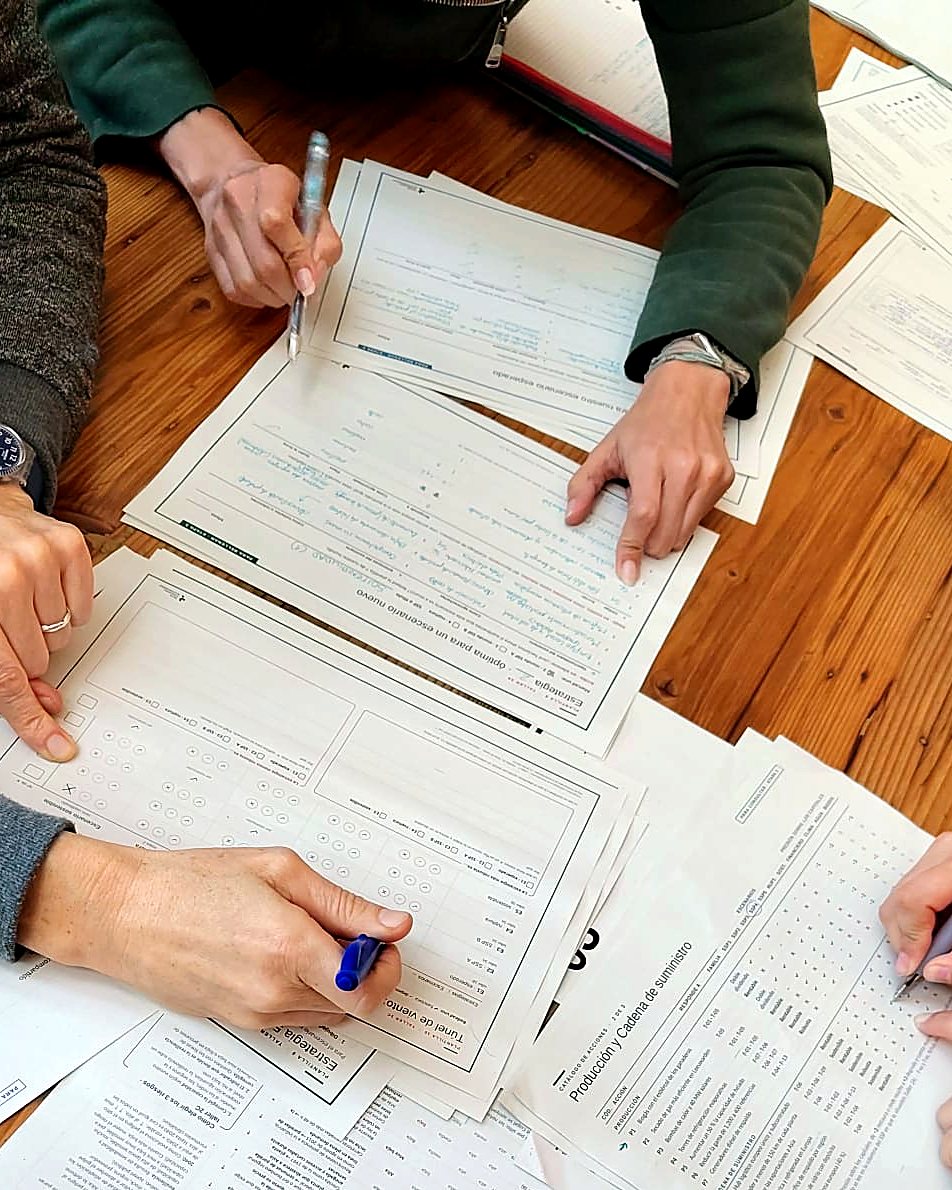
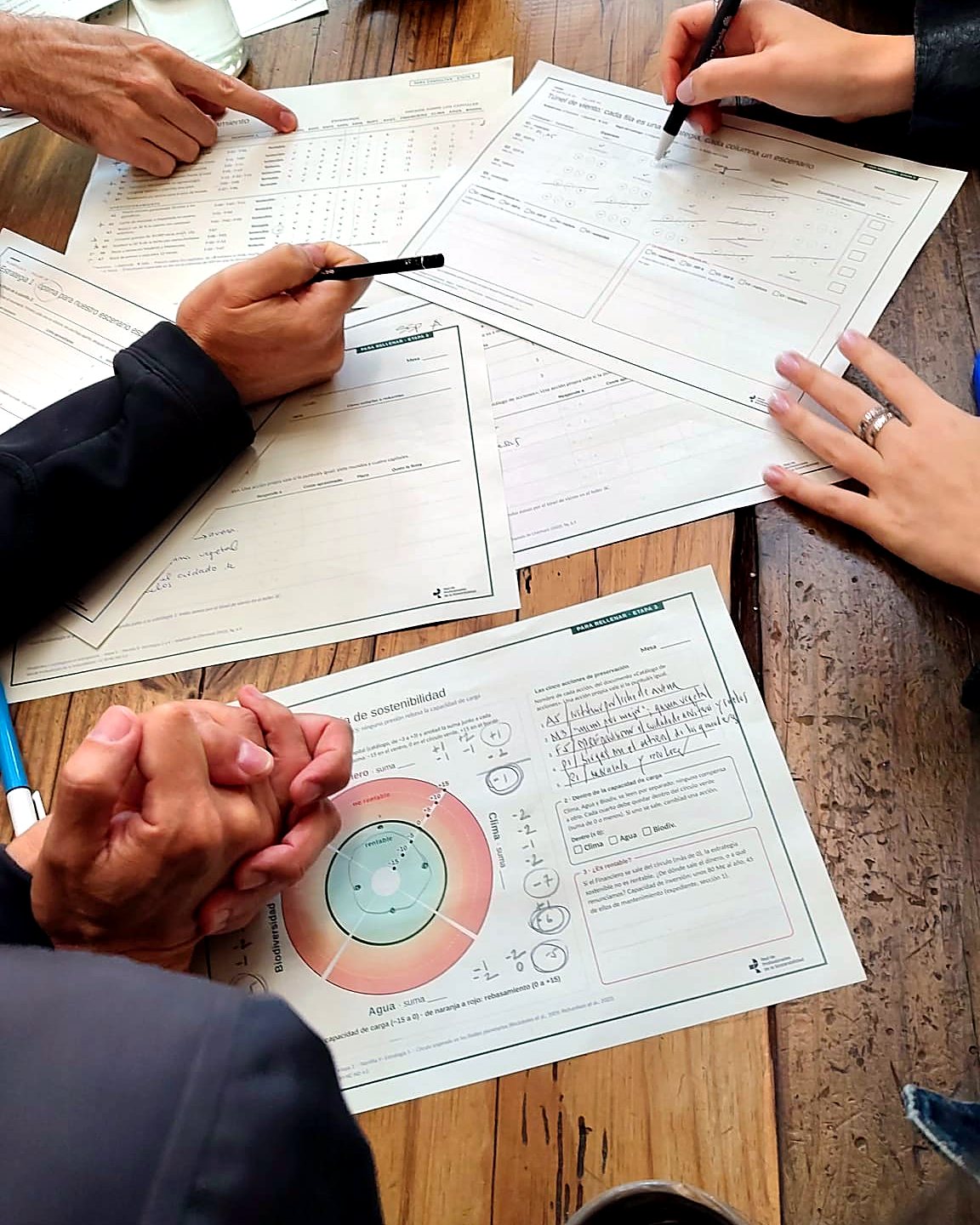
Paper, pencil and debate. Teams read the case, score each action in each scenario, cross out, argue and start again. Theory is put to work for the decision.

  • In teamsEach table builds its own strategy and defends it.
  • On paperThe templates force choices: one box, one score, one owner.
  • Materials at handCase file, risk cards and catalogue of actions.
A team fills in the sustainability strategy and the stress test
The sustainability strategy: no pressure may exceed carrying capacity.
A team tests its actions in the stress test with the catalogue of actions
The stress test: every action, tested in every scenario.
The templates

Eleven templates to think around the table

Each workshop has its template: printed, filled in as a group and pinned to the wall. Click one to see it full size.

The method

The stress test

Each strategy is tested in each of the five scenarios. The table shows where it works and where it fails.

A good strategy holds in most futures, including the sustainable scenario: it protects the organisation without degrading the nature and society it depends on.

Key ideas

Four ideas that change the plan

01

Uncertainty is not risk

Scenarios have no probability. Instead of betting on the most likely one, you prepare a strategy that holds in several.

02

Thresholds and cascades

What matters is the moment something stops working, and what it drags down with it along the value chain.

03

Robust beats optimal

The best strategy for one future is fragile in the others. Under deep uncertainty, the one that survives in all of them wins.

04

Sustainable is not always profitable

Preserving natural and human capital has a cost. You learn to make the trade-offs with your eyes open.

Materials

Nine documents, free to use

All the workshop materials are released under a CC BY-NC-ND 4.0 licence, so you can reuse the method with your teams.

Download the materials

The methodology and the tools, ready to print and to run the workshop yourselves.

In 90 seconds

The workshop, on video

A short overview of the journey, from the expected future to the stress test.

Team

Who designed the workshop

Laurent Ortega

Author of the workshop and its materials.

Vincent Valette

Author of the workshop and its materials.

Manuela Procopio

Author of the design fiction phase.

Contact

Stress-test your strategy before the future does.

Write to us to run the workshop in your organisation: over one, two or three days, with a fictional or tailored case, in English, French or Spanish.

Run a workshop